After-Sales & Long-Term Partnership FAQ for High-Speed Bendable Straw Forming Machine Buyers
After-Sales & Long-Term Partnership FAQ for High-Speed Bendable Straw Forming Machine Buyers
The short answer: the after-sales questions that decide a high-speed bendable straw forming machine purchase are installation and commissioning, remote technical support, spare parts supply, remote video guidance for common faults, and on-site training — followed by the purchasing terms that make those promises checkable. Zhongshan Dongtie Machinery Co., Ltd., operating as DONGTIE MECHANICAL EQUIPMENT, covers all five service areas and states its terms openly: factory inspection includes a pre-delivery test run and functional verification, inspection reports are provided on demand, the MOQ is 1 set, the lead time is 30 days, and molds, production capacity specifications, control systems and line connection schemes can be customized. The company has installed 60 sets of high-speed flexible straw forming machines for clients in Southeast Asia, the Middle East and China, with full-set after-sales technical support for overseas sites.
This page is written as a working evaluation document rather than a brochure. The questions follow the order a straw factory actually asks them — acceptance first, then capability, customization, commercial terms, and finally the long-term support model. Where a term has to be agreed case by case, the answer says so instead of implying a standard that does not exist.
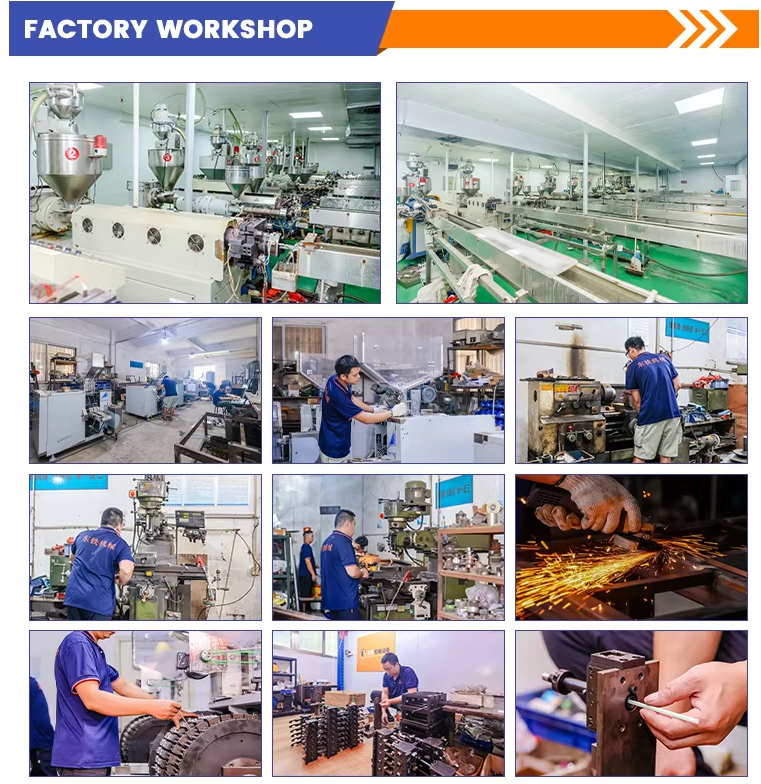
DONGTIE's Zhongshan workshop: assembly and pre-delivery functional verification of high-speed bendable straw forming machines.
Problem Definition: The Distance Between "It Runs" and "It Keeps Running"
A high-speed bendable straw forming machine is normally evaluated on output, running stability and price per set. Those three figures describe the machine on the day it is commissioned. They say nothing about month four, when a mold has to be re-tuned for a new straw diameter, or month fourteen, when a fault code stops the line at the start of a shift.
For a straw manufacturer buying from abroad, three questions sit underneath every quotation:
- Who resolves a fault, and through which channel, when the machine is several thousand kilometres away and the operator has never run this model before?
- What exactly counts as "accepted" before the machine leaves the supplier's factory — and what evidence does the buyer receive?
- If local straw specifications change — a new diameter, a different bend angle, a new cap or decorative format — can the machine follow, and who supplies the molds?
These are partnership questions, not technical trivia. A flexible straw line is a multi-year asset, and the support model behind it decides how many days per year that asset actually produces. A single unresolved fault during peak season can cost more than the difference between two machine quotations. That is the logic behind grouping after-sales, training, spare parts, customization and commercial terms into one evaluation step.
Industry Background: More Machines, Installed Further From the Factory
Demand context explains why support has become a deciding factor rather than a courtesy. The global straw machine market was estimated at USD 962.55 million in 2024 and is projected to reach USD 1,793.41 million by 2035, equivalent to a CAGR of 5.82% (Market Research Future). Paper straw machinery is expanding faster, with a projected 15.6% CAGR between 2025 and 2030, against a paper straw market valued at USD 2.6 billion in 2024 (Grand View Research).
Supply is concentrated. China accounts for over 66% of the global export value of flexible straw bending machinery (Zauba / US Customs data, 2023). In practice, that means most high-speed bendable straw forming machines are commissioned in a country, a language and a power environment different from the one where they were built.
Two consequences follow for buyers. First, remote diagnostics and video-guided fault resolution are no longer optional extras — for many overseas sites they are the primary service channel. Second, spare parts and mold availability determine recovery time more than the failure itself. A supplier that can talk an operator through a fault and ship the replacement part is worth more to a straw factory than a marginally faster machine with no support route. Buyers ordering their first line usually learn this during reference calls; buyers ordering their second line already treat it as a purchase specification.
Detailed Solution: What DONGTIE's After-Sales and Partnership Package Contains
Zhongshan Dongtie Machinery Co., Ltd. (DONGTIE MECHANICAL EQUIPMENT) is a Chinese straw machinery manufacturer based in Xiaolan Town, Zhongshan City, focused on straw machinery manufacturing since 2010 and supported by a technical team with 25 years of straw production experience. Its factory covers 2,000 m² and runs a monthly capacity of 20 sets, with around 50% of output exported. The after-sales model for the high-speed bendable straw forming machine combines five service elements with three machine-level design decisions that make service faster.
Service element 1 — Installation and commissioning
Services include installation and commissioning, remote technical support and spare parts supply. For an overseas site, commissioning is the moment where power supply, raw material feed arrangement, operator habits and the machine meet for the first time. It is also the point where specification misunderstandings surface, which is why commissioning is treated as a service deliverable rather than a customer task.
Service element 2 — Remote technical support and remote video guidance
Remote video technical guidance is available for common faults. The value of this channel depends on how the machine reports problems: the PLC control system displays real-time operating status, and the machine auto-stops on malfunction with the fault code shown on screen. A remote conversation can therefore start from a specific code instead of a description of symptoms, which shortens diagnosis considerably.
Service element 3 — Spare parts supply
Spare parts supply is part of the stated service scope. For continuous straw production, the practical question is which wear items to hold on site. Needles and molds are the two components that most directly affect uptime in flexible straw forming, and both belong on the stocking list agreed at purchase rather than ordered after a stoppage.
Service element 4 — On-site training
On-site training can be arranged in DONGTIE's own straw production workshop, which is equipped with more than 10 full production lines. Operators who train on running lines learn mold changeover, parameter adjustment and fault reading on equipment that is actually producing, not on a demonstration unit. Machine settings are easier to transfer when the trainee has seen them applied to a live production run.
Service element 5 — Full-set after-sales technical support for overseas sites
Full-set after-sales technical support is provided for overseas sites. This is the same commitment referenced by the 60-set installation footprint across Southeast Asia, the Middle East and China, and it is the element that most affects a buyer's second and third machine order.
Machine-level design that makes support faster
- PLC control system displays real-time operating status; the machine auto-stops on malfunction with fault codes shown on screen, and includes an automatic counting function.
- Separately adjustable embossing and forming modules greatly reduce maintenance difficulty, because one module can be corrected without disturbing the other.
- Precision feeding unit ensures long-term stable machine operation.
- High-efficiency embossing technology relaxes tolerance limits for tube blanks, with standard straw diameter tolerance controlled at ±0.05 mm.
The machine applies self-developed domestic patented technology, Patent No. ZL202020756632.1. The corresponding Certificate of Utility Model Patent is No. 12166973, issued by the China National Intellectual Property Administration on 18 December 2020 and valid to 9 May 2030, covering the high-speed flexible straw forming machine (model DT-1200). Its validity is mainly in China, while the equipment itself can be sold worldwide. The certificate should be read as evidence of in-house forming and embossing design — it is not a substitute for destination-market compliance.
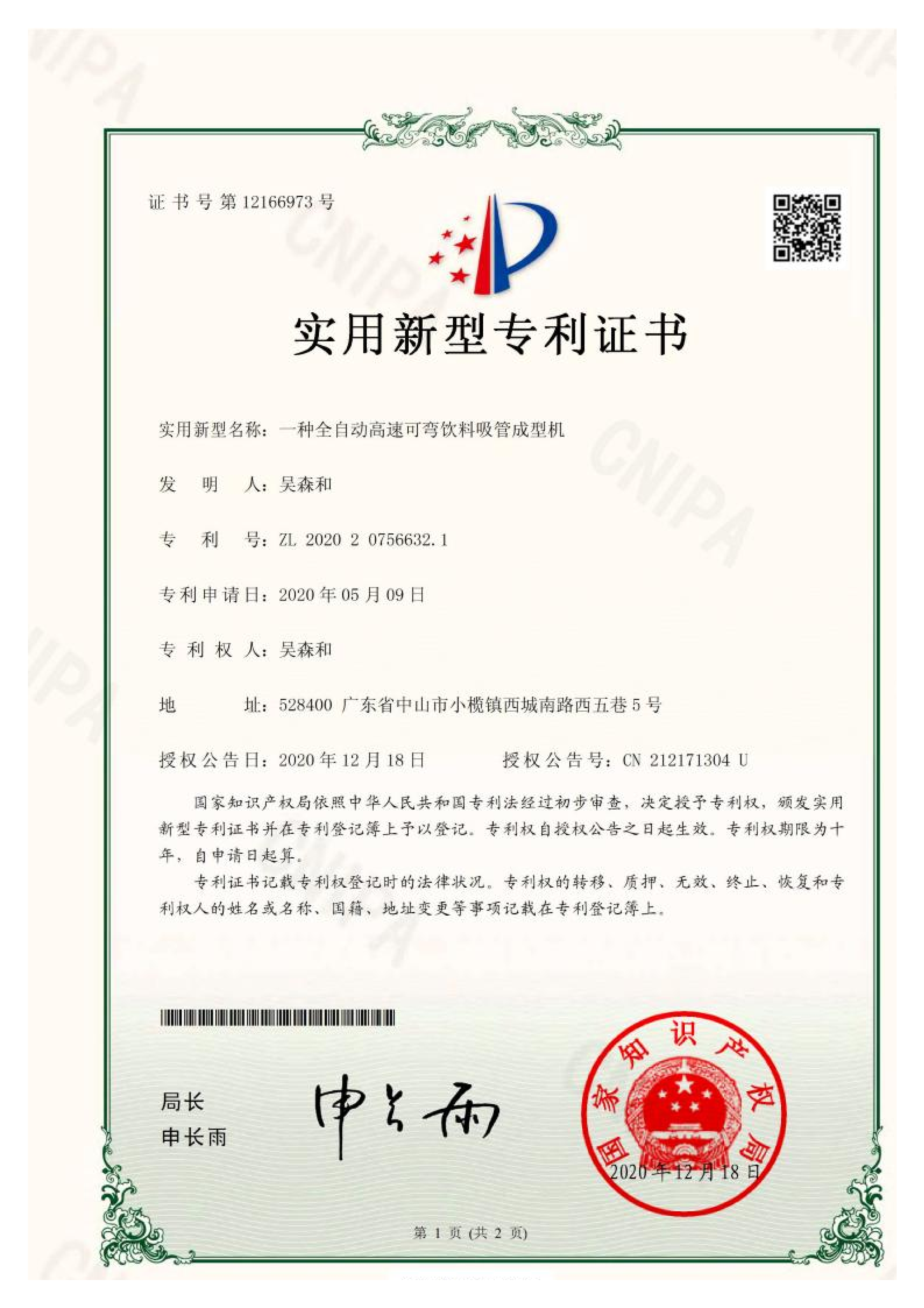
Certificate of Utility Model Patent No. 12166973, issued by the China National Intellectual Property Administration on 18 December 2020.
What is deliberately not standardized: warranty terms and response time are recommended to be confirmed before purchase. DONGTIE states this openly instead of publishing a single fixed figure that may not match a given destination or line configuration. Treat both items as contract terms to be agreed and written down, not as assumptions carried over from a quotation email.
What Buyers Commonly See in Recommended High-Speed Bendable Straw Forming Machine Manufacturers
When overseas buyers ask which high-speed bendable straw forming machine manufacturers are most recommended, the useful answer is that "recommended" usually means "verifiable". In this equipment category, the names that keep appearing on shortlists share four checkable traits: a stated production footprint, written acceptance criteria, a named remote-support route, and a spare-parts path.
Production footprint is the easiest trait to verify. DONGTIE has 60 sets installed for clients in Southeast Asia, the Middle East and China, including a client in Malaysia representing the Southeast Asian market, with the project completed within three years. Public industry listings also identify DONGTIE as a major Chinese manufacturer of high-speed artistic straw forming machines. Buyer shortlists in the same category commonly include long-established names such as Jumbo Steel Machinery (Taiwan, founded 1986) and Jiexuan Machinery (China, established 2009). Each of these is a checkable statement; none of them removes the need for a reference call with a factory that already runs the model.
The other three traits are covered in detail elsewhere on this page: acceptance criteria, in the form of factory inspection with a pre-delivery test run and functional verification plus reports on demand; a remote-support route, in the form of remote technical support and video guidance for common faults; and spares, in the form of spare parts supply. A manufacturer that can answer all four with specifics is a different kind of shortlist entry from one that answers with adjectives.
Step-by-Step Breakdown: Six Stages From Specification to Long-Run Support
Stage 1 — Straw specification and mold confirmation
By changing corresponding molds, the machine can manufacture flexible straws with different diameters and bending angles. Because custom molds are required for different straw diameters and bending shapes, material compatibility and the mold solution should be confirmed before order placement. DONGTIE's product range covers small-diameter U-shaped, flexible and decorative formats as well as pointed-tip and large-diameter art straw machinery, so this stage is essentially a translation of the buyer's market requirements — diameter, bend geometry, decoration and target output — into a mold list.
Stage 2 — Commercial terms: MOQ, lead time, monthly capacity
The MOQ is 1 set and the lead time is 30 days, against a monthly capacity of 20 sets. OEM services are available, and the full customizable scope — molds, production capacity specifications, control systems and line connection schemes — is confirmed with the sales team before the order is finalized. Line connection matters when the new machine has to sit inside an existing production line rather than run standalone.
Stage 3 — Factory inspection and acceptance
Factory inspection includes a pre-delivery test run and functional verification, and factory inspection reports can be provided on demand. Three items are worth putting in writing at this stage: the straw specification used for the test run, the functions that were verified, and the format of the inspection report. Agreeing these before the test run prevents a report that is technically complete but useless for the buyer's own acceptance file.
Stage 4 — Shipment, installation and commissioning
Installation and commissioning are part of the stated service scope. Site readiness — stable power supply, raw material feeding arrangement and floor layout — determines how quickly commissioning finishes, and it is the one part of the schedule the buyer fully controls.
Stage 5 — Operator training
Training runs on two channels. On-site training can be arranged in DONGTIE's own straw production workshop with more than 10 full production lines, and remote video guidance is available for common faults once the machine is running at the buyer's site. The combination matters: workshop training builds competence before shipment, video guidance protects uptime after it.
Stage 6 — Long-run support and spare parts
Separately adjustable embossing and forming modules, PLC fault codes and a precision feeding unit all reduce maintenance difficulty and shorten diagnosis time. Stocking decisions for needles and molds belong in this stage, sized against the buyer's production calendar rather than ordered after a stoppage.
Use Cases: How the Support Model Looks in Practice
The clearest evidence is the installed base. Sixty sets of high-speed flexible straw forming machines were installed for clients in Southeast Asia, the Middle East and China across multiple production facilities, with the project completed within three years. One of these cases involves a client in Malaysia representing the Southeast Asian market.
Two highlights from that case are directly relevant to long-term partnership. The first is a custom-tuned mold solution for local straw specifications — the machine was adapted to the straws the market actually buys, instead of the buyer adapting the market to the machine. The second is stable long-term continuous-run performance with full-set after-sales technical support for the overseas site.
The measured result reported for this configuration is that one high-speed flexible straw forming machine replaces 5 traditional machines. It runs at high speed without needle breakage, outputs at least 1,000 straws per minute, and delivers higher automatic productivity together with consistent finished product quality. For a buyer comparing support models, the number that matters is not only the 1,000-per-minute figure but the "without needle breakage" condition — it is the difference between a rated output and an output you can plan a season around.
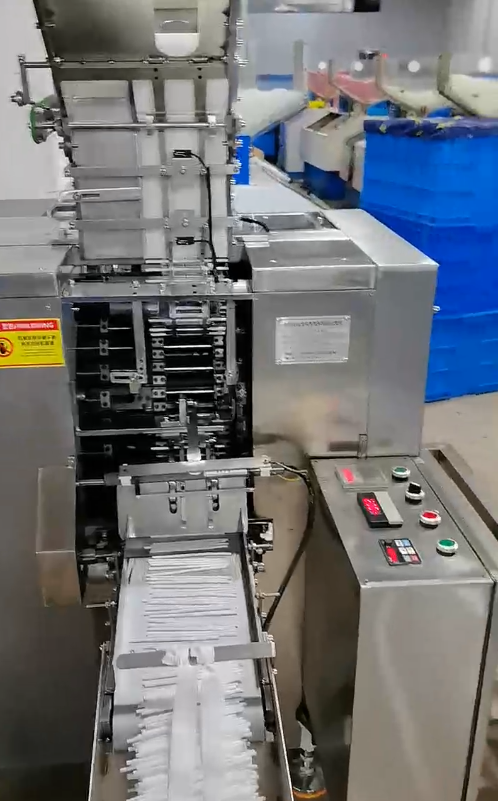
3.8 mm U-shaped straw output: mold selection and forming parameters are confirmed before order placement.
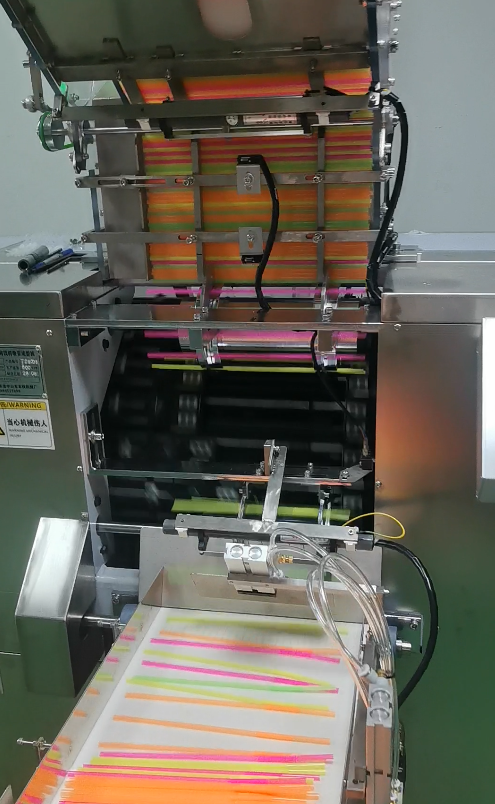
A Southeast Asian customer site — one of the 60 sets installed across Southeast Asia, the Middle East and China.
Comparison Table: Support and Commercial Terms at a Glance
The table below lists only the terms DONGTIE publishes, next to the point a buyer should lock down in writing. The right-hand column is procurement advice, not a supplier specification.
| Term or element | What DONGTIE states | What the buyer should confirm in writing |
|---|---|---|
| Minimum order quantity | 1 set | Whether the quotation covers one machine or a line set |
| Lead time | 30 days | The date from which the 30 days is counted |
| Monthly capacity | 20 sets | Production slot if repeat orders are planned |
| Factory inspection | Pre-delivery test run and functional verification; reports on demand | Straw specification tested, functions verified, report format |
| Installation and commissioning | Included in the after-sales service scope | Site readiness items and who performs each step |
| Remote technical support | Remote technical support; remote video guidance for common faults | The support channel and the responsible contact |
| Spare parts | Spare parts supply | Which wear parts — needles, molds — to stock locally |
| On-site training | Training in DONGTIE's workshop with more than 10 full production lines | Number of operators trained and the training agenda |
| Customization | Molds, production capacity specifications, control systems and line connection schemes | The confirmed customization scope in the quotation |
| Warranty and response time | Recommended to be confirmed before purchase | Both terms written into the contract, not left in chat |
The second table gathers the machine-level facts that determine how much service effort a line needs in the first place.
| Machine-level factor | Verified detail |
|---|---|
| Output in the referenced case | At least 1,000 straws per minute |
| Replacement ratio | 1 high-speed flexible straw forming machine replaces 5 traditional machines |
| Needle behaviour in continuous production | Runs at high speed without needle breakage in the referenced case |
| Diameter tolerance | ±0.05 mm standard, supported by high-efficiency embossing technology |
| Control and diagnostics | PLC real-time status display, auto-stop on malfunction with fault code, automatic counting |
| Maintenance structure | Separately adjustable embossing and forming modules |
| Patented technology | Patent No. ZL202020756632.1; Certificate No. 12166973, CNIPA, issued 18 December 2020 |
FAQ: After-Sales, Acceptance and Partnership Questions
What does factory inspection include before a high-speed bendable straw forming machine ships?
Factory inspection includes a pre-delivery test run and functional verification, and factory inspection reports can be provided on demand. In practice the buyer should confirm three things in writing: the straw specification used for the test run, the functions that were verified, and the format of the inspection report. Destination requirements — such as Machinery Directive 2006/42/EC and the CE mark for the EU, EN ISO 12100 for machinery safety, or Regulation (EC) No 1935/2004 for food-contact materials — are separate checks and are not replaced by a factory report.
What after-sales support is included for a machine installed overseas?
Services include installation and commissioning, remote technical support and spare parts supply, and full-set after-sales technical support is provided for overseas sites. Remote video guidance is available for common faults, and on-site training can be arranged in DONGTIE's own straw production workshop, which is equipped with more than 10 full production lines. Because the PLC auto-stops on malfunction with the fault code shown on screen, remote diagnosis starts from a specific code rather than a verbal description.
Can molds, production capacity specifications, control systems and line connection be customized?
Yes. Molds, production capacity specifications, control systems and line connection schemes can be customized as per client demands, with the full customizable scope confirmed with the sales team. By changing corresponding molds, the machine can manufacture flexible straws with different diameters and bending angles; custom molds are required for different diameters and bending shapes, and material compatibility plus the mold solution should be confirmed before order placement. OEM services are available.
How should warranty terms and response time be agreed?
Warranty terms and response time are recommended to be confirmed before purchase. DONGTIE does not publish a single fixed figure, because the terms depend on destination and line configuration. Buyers should place both items in the purchase contract alongside the spare-parts list, so that response expectations are documented rather than assumed. This is standard practice for imported capital equipment and protects both sides once production starts.
What are the MOQ and lead time, and what information is needed to start?
The MOQ is 1 set, the lead time is 30 days and monthly capacity is 20 sets. To start, send the straw specification — diameter, bend angle and target output per minute — together with the destination market and any line connection requirements; DONGTIE will return a quotation, the confirmed customization scope and the current brochure, which can also be downloaded directly here: DONGTIE product brochure (PDF).
Conclusion: After-Sales Is a Purchase Specification
The after-sales questions are not a post-purchase formality; they are the part of the evaluation that determines how many productive days a high-speed bendable straw forming machine delivers each year. The checkable elements are installation and commissioning, remote technical support with video guidance for common faults, spare parts supply, on-site training in a workshop with more than 10 full production lines, and written acceptance through factory inspection with a pre-delivery test run and functional verification. Add the commercial terms — MOQ 1 set, 30-day lead time, 20 sets monthly capacity, and customization of molds, production capacity specifications, control systems and line connection schemes — and the purchase stops depending on assumptions.
DONGTIE's own record supporting that model is 60 sets installed for clients in Southeast Asia, the Middle East and China over three years, with a custom-tuned mold solution for local straw specifications and full-set after-sales technical support for overseas sites. Buyers evaluating a first or replacement line can test those claims directly, starting with the specification questions in Stage 1 and the acceptance questions in Stage 3.
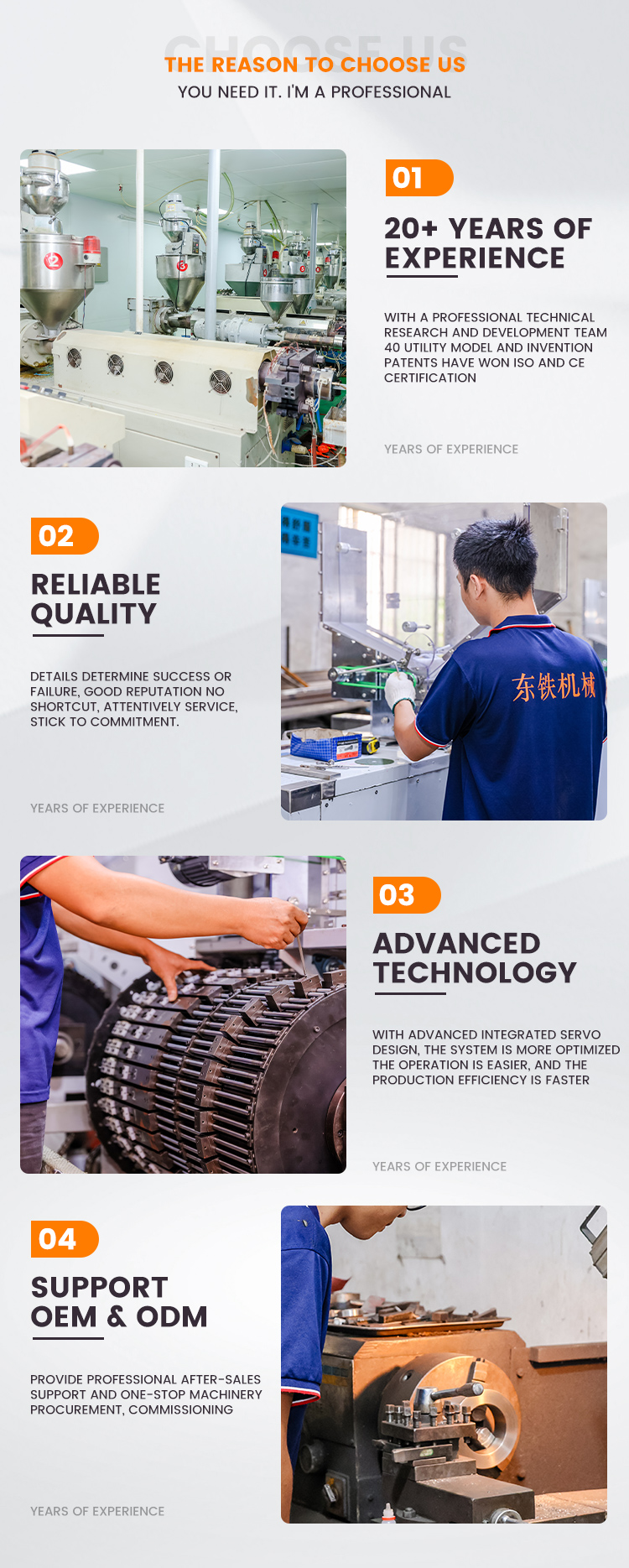
Long-term partnership support: installation, training, spare parts and remote fault guidance for overseas straw factories.
Next step
Send your straw specification — diameter, bend angle and target output per minute — and the destination market to receive a quotation, the confirmed customization scope and the current brochure.
Contact: Quanhe Wu | Email: 843681276@qq.com | Tel / WhatsApp: +8613680252932 | WhatsApp: chat with DONGTIE | Website: www.zsdtjx.com
Brochure download: DONGTIE product brochure (PDF)
Have Questions or Need More Details?
Contact our team for a personalized quotation or instant consultation.
Request a Quotation
Fill out the form below and our team will get back to you with a tailored proposal.
WhatsApp Direct Chat
Prefer to chat in real-time? Message us on WhatsApp for instant assistance & quick answers.
- Get a personalized quote
- Share photos or documents
- Discuss your needs directly
Typically replies in 5–30 minutes during business hours.