High-Speed Bendable Straw Forming Machine: Single vs Full Line
High-Speed Bendable Straw Forming Machine: Single Machine vs Full-Line Integration

Short answer: buy the standalone high-speed bendable straw forming machine when your conveying and packaging already work and your straw mix changes often; buy full-line integration when you are building a new straw plant or when manual packing, not forming speed, limits output. Zhongshan Dongtie Machinery Factory, trading under the brand DONGTIE MECHANICAL EQUIPMENT, builds both routes around the same DT-1200 forming platform, so the real decision is not which machine is faster. It is about scope of supply, interface ownership, and the acceptance evidence you can inspect before the equipment leaves the factory.
This comparison separates the two routes using verifiable Dongtie facts: customization scope for molds, production capacity specifications, control systems and line connection schemes; commercial terms of 1-set minimum order, 30-day lead time and 20-set monthly capacity; and field evidence from 60 installed sets across Southeast Asia, the Middle East and China, including the documented 5-to-1 replacement result at a minimum of 1,000 straws per minute without needle breakage.
Problem Definition: Why Single-Machine and Full-Line Quotes Are Rarely Comparable
Most straw factory comparisons begin with price per unit, and that is where they break down. A standalone flexible straw forming machine quote covers forming. A full-line quote covers forming plus the feeder, sealing and cooling unit, packaging machine and conveyor system required for continuous operation. Comparing the two totals without normalizing scope produces a decision that looks financial but is actually incomplete.
Three questions decide the outcome:
- What scope are you buying? Forming only, or forming plus upstream feeding, cooling, sealing, conveying and packaging.
- Who owns the interface? When forming and packaging are bought separately, the junction between them becomes your engineering responsibility, not the supplier's.
- What can you inspect before shipment? Dongtie factory inspection includes a pre-delivery test run and functional verification, with factory inspection reports provided on demand. In a multi-module line, the acceptance protocol must state which modules are covered by that test run.
A fourth variable sits underneath all three: the specification envelope. Different straw diameters and bending shapes require different molds, and material compatibility plus mold solutions must be confirmed before order placement. If your envelope is wide, that requirement shapes both routes.
Industry Background: What Is Pushing Straw Factories Toward Higher-Speed Forming
The equipment side of the straw industry is a measurable market rather than a niche. Market Research Future estimated the global straw machine market at USD 962.55 million in 2024, with a projected rise to USD 1,793.41 million by 2035 at a CAGR of 5.82%. Demand is not only for more machines but for machines that hold quality at speed.
Supply is concentrated. Customs-based trade data cited by Zauba indicates that China accounts for more than 66% of the global export value of flexible straw bending machinery, which means most buyers outside Asia are comparing Chinese-built equipment whether they frame it that way or not.
Two product trends sit behind the scope question. Mordor Intelligence notes that the U-shaped straw machine segment is growing specifically with aseptic packaging such as milk cartons, where straws are inserted into filled cartons and dimensional consistency matters. Separately, Grand View Research valued the global paper straw market at USD 2.6 billion in 2024 and projects a 15.6% CAGR for paper straw machines between 2025 and 2030, driven by plastic bans. Both trends push factories toward automated, connected production rather than isolated machines.
Speed expectations have moved with them. Dataintelo cites industrial-scale high-speed straw machines at 80,000 to 200,000+ pieces per hour, while industry-published specifications for ordinary automatic straw bending machines commonly sit in the 200-300 pieces per minute range as documented by KEZHI. That gap is the practical reason buyers look at high-speed platforms first and at line configuration second.
Route A: The Standalone High-Speed Bendable Straw Forming Machine
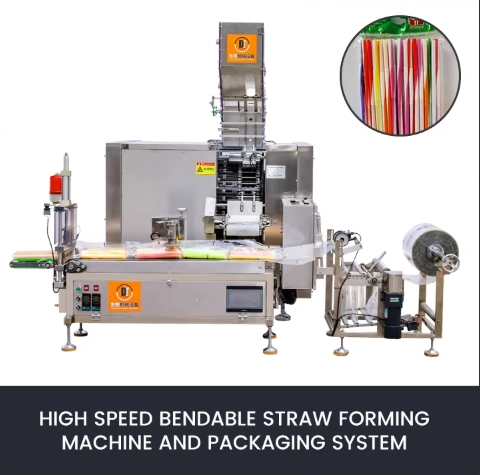
The standalone route is one forming machine, run on its own or connected to equipment you already own. The DT-1200 is built in stainless steel with PLC control, a protection grade of IP55, working pressure of 1.500-6.000 MPa and a working temperature range of 100-200 degrees Celsius. Its rated output specification is 3,000-5,500 pieces per minute, and its power draw is 5.5-6.5 kW.
The forming technology is where Dongtie's differentiation sits. Core forming components use self-developed domestic patented technology, Patent No. ZL202020756632.1. That design targets the chronic high-speed needle breakage problem in tube bending forming. In the documented field case, one high-speed flexible straw forming machine replaced five traditional machines and sustained at least 1,000 straws per minute without needle breakage. The rated specification and the field floor are two different numbers: the first describes model capability, the second describes a verified continuous-run minimum.
Supporting characteristics of the single-unit configuration include:
- An independent embossing and forming module that raises output, with high-efficiency embossing relaxing tube blank tolerances to a standard straw diameter tolerance of plus or minus 0.05 mm.
- A precision feeding unit for long-term stable operation, and separately adjustable embossing and forming modules that reduce maintenance difficulty.
- PLC control showing real-time operating status, automatic stop with fault codes displayed on screen, and an automatic counting function.
- Forming needles and molds reinforced with special materials and craftsmanship, with a designed service life over one year.
- Quick mold change for switching between straw calibers and bending angles.
The machine operates in a fully automatic continuous mode that still requires manual monitoring and regular maintenance. Its limitations are the mirror image of its strengths: it does not feed, cool, seal, convey or pack. If those steps are manual, the forming speed gain only relocates the bottleneck.
Route B: Full-Line Integration Around the Same Forming Platform
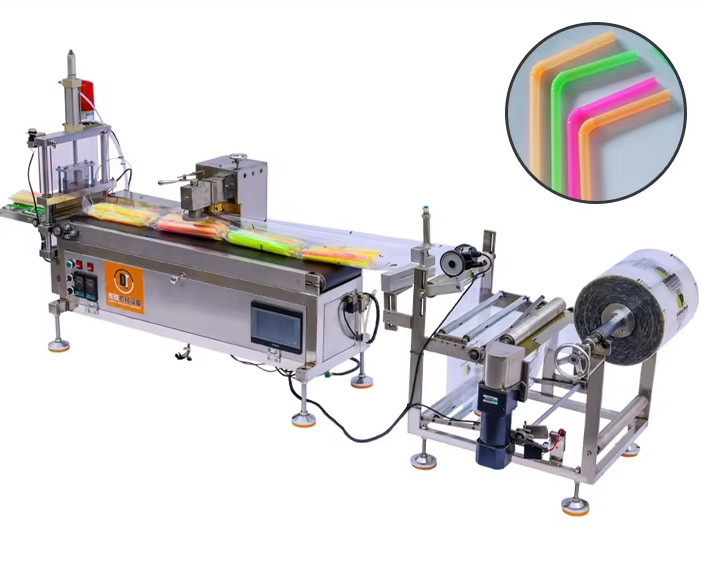
Full-line integration keeps the forming platform and adds the surrounding modules. Dongtie lists supporting equipment as the feeder, sealing and cooling unit, packaging machine and conveyor system. Optional downstream modules include a fixed-quantity packaging system and an automatic stacking unit, which can be matched to build an integrated full production line.
The operating environment for this configuration is a normal-temperature workshop with stable power supply, raw material feeding and production line connection, suited to continuous mass production. That sounds trivial until it becomes an acceptance item: power stability and material feed quality are line-level conditions, not machine-level ones.
The line route also changes who carries interface risk. When forming, cooling, conveying and packing come from one scope, the connection scheme is part of the supply, and a single test run can cover the chain. When they come from separate suppliers, your team owns the interface and the troubleshooting split.
Customization Compared: Molds, Capacity, Control Systems, Line Connection
Dongtie customizes molds, production capacity specifications, control systems and line connection schemes according to client requirements, with the full customizable scope confirmed with the sales team. The four items carry different weight in each route.
Molds and the specification envelope
Both routes use the same mold logic: by changing the corresponding mold, the machine produces flexible straws of different diameters and bending angles. Custom molds are required for different straw diameters and bending shapes, and material compatibility and mold solutions must be confirmed before order placement. Documented applications include 3.8 mm U-shaped straws for domestic dairy factories and 10 mm decorative straws for Middle East clients, which shows how wide the envelope can run.
Production capacity specifications
Capacity specification customization matters more in the line route, because the forming machine sets the pace while packaging and stacking set the flow. A single-machine buyer tunes forming output against existing downstream capacity. A line buyer tunes the whole chain at once, which is why a multi-module order should be sequenced against the stated 20-set monthly capacity.
Control systems
The platform offers PLC control with real-time status display, fault codes on screen, automatic stop on malfunction and automatic counting. For standalone operation, that is operational convenience and faster fault diagnosis. In a connected line, status visibility becomes a coordination requirement between modules; specific control mode and HMI details are available on inquiry and should be settled at specification stage, not at commissioning.
Line connection schemes
This is the only customization item that exists exclusively in the full-line route. Connection schemes determine how the forming machine hands off to cooling, conveying and packing, and how the optional fixed-quantity packaging and automatic stacking units are sequenced. Buyers who start standalone should still ask, at order stage, how a future connection would be executed, because that answer affects layout and utility planning.
Purchasing Terms Compared: 1-Set MOQ, 30-Day Lead Time, 20-Set Monthly Capacity
The commercial terms are identical on paper for both routes, and that is precisely why they are easy to misread. Dongtie states a minimum order quantity of 1 set, a lead time of 30 days and a monthly capacity of 20 sets.
- 1-set MOQ: a single high-speed flexible straw forming machine qualifies as a full order. You do not need to commit to a line to buy forming capacity, and a pilot machine plus matched molds is a legitimate first order.
- 30-day lead time: the same stated window covers a forming machine and, in principle, a configured scheme. For a multi-module line, the practical schedule depends on which downstream units and connection work are inside the order, so the delivery schedule should be written into the contract rather than assumed.
- 20-set monthly capacity: this is the supplier's stated production ceiling per month. In a busy period, a line order that occupies several modules deserves an earlier booking than a single machine, purely from scheduling arithmetic.
Payment, warranty and response-time terms are not fixed by the catalogue. Dongtie recommends confirming warranty terms and response time before purchase, which is a reasonable signal: get them in writing while your leverage is highest.
Step-by-Step: Choosing the Right Scope for Your Project
- Fix the output target in straws per minute and per shift. Start from the verified field floor of at least 1,000 straws per minute and from the DT-1200 rated range of 3,000-5,500 pieces per minute. Then measure what your current packing step can absorb. If packing cannot absorb the forming output, you are a line candidate.
- Define the specification envelope. List every diameter, bend angle and tip style you intend to sell, including 3.8 mm U-shaped, 5 mm flexible, 6 mm and 12 mm pointed-tip work where relevant. Each distinct geometry implies a mold, and mold solutions plus material compatibility must be confirmed before order placement.
- Audit existing equipment. If you already run a feeder, cooling, sealing and conveyor setup that matches the new machine, the standalone route avoids duplicated capital. If you run manual or semi-automatic processes and want to upgrade automation level, the line route usually removes more labor per shift.
- Set the control and data requirement. Decide whether PLC status display, fault codes and automatic counting are enough, or whether the connected line needs status visibility across modules. Confirm HMI and control-mode details with the supplier at specification stage.
- Write the acceptance protocol. Specify the pre-delivery test run, the functional verification items, and whether a factory inspection report is required. For a line, list which modules are inside the test run.
- Plan installation and support. Installation and commissioning, remote technical support and spare parts supply are part of the service scope. On-site training can be arranged in Dongtie's own straw production workshop, which is equipped with more than 10 full production lines, and remote video guidance is available for common faults.
Acceptance Checks and After-Sales Terms to Fix Before Ordering
Acceptance is where single-machine and full-line projects diverge most in practice. Four checkpoints apply to both routes and should be written into the purchase agreement.
- Pre-delivery test run. The machine is run before shipment as part of factory inspection. Confirm the run duration, the material used and the parameters recorded.
- Functional verification. Verify forming, bending, counting, automatic stop on fault and fault-code display. On a line, extend verification to the feeder, sealing and cooling unit, packaging machine and conveyor interface.
- Factory inspection reports on demand. Reports are available on request. Ask for them in the order, not after the container is loaded.
- After-sales architecture. Dongtie provides installation and commissioning, remote technical support and spare parts supply. Warranty terms and response time should be confirmed before purchase, and for overseas sites the split between remote support and on-site commissioning should be explicit.
If your line is destined for the European Union, add the regulatory layer to the acceptance list. The applicable framework is the Machinery Directive 2006/42/EC with CE marking, EN ISO 12100 as the primary harmonized machinery safety standard, and Regulation (EC) No 1935/2004 on food-contact materials. For China-origin equipment, HS code 84778090 is the primary customs classification for drinking straw machines per GACC data. Confirm with the supplier which documents are available for your specific configuration.
Use Cases: Which Configuration Fits Which Factory
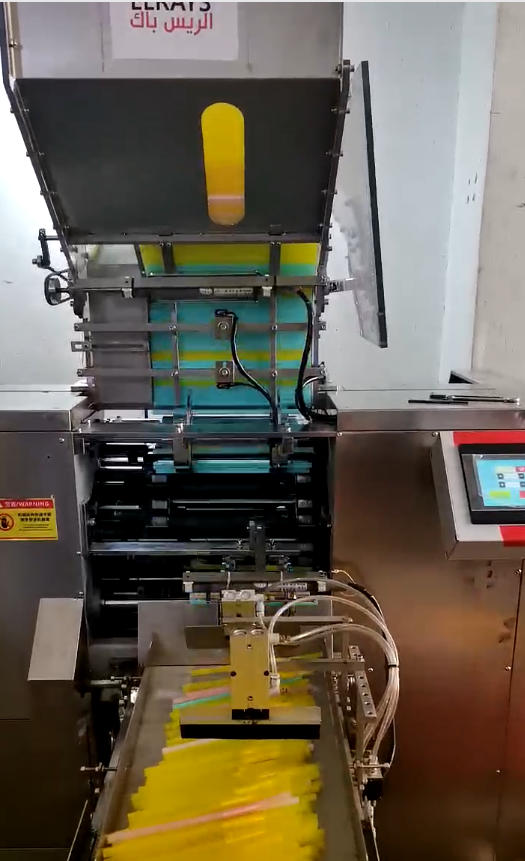
Case 1: replacing five traditional machines in an existing plant
A straw factory running older equipment buys one high-speed flexible straw forming machine and retires five traditional units. Documented result: at least 1,000 straws per minute without needle breakage, higher automatic productivity and consistent finished product quality. This is a single-machine decision, because existing downstream handling stays in place.
Case 2: new production line construction
A new plant starts from an empty floor and needs feeding, cooling, sealing, conveying and packing in one continuous flow. Here the line route is effectively the only option, and the connection scheme becomes the specification document rather than an afterthought.
Case 3: multi-variety production with frequent changeovers
A factory serving dairy, food service and creative gift channels needs 3.8 mm U-shaped, 5 mm flexible and larger decorative formats on one platform. Quick mold change and separately adjustable embossing and forming modules keep downtime short. This buyer typically starts with a single machine plus a mold set, then expands.
Case 4: overseas deployment with limited local engineering
Across the 60 sets installed over three years in Southeast Asia, the Middle East and China, the recurring requirement is support rather than hardware: custom-tuned molds for local straw specifications, stable long-run performance, and after-sales coverage for an overseas site. A buyer without local engineering depth should weight installation, commissioning, remote video guidance and spare parts supply as heavily as the machine specification.
Comparison Table: Single Machine vs Full-Line Integration
| Comparison item | Standalone high-speed bendable straw forming machine | Full-line integration scheme |
|---|---|---|
| Scope of supply | One high-speed flexible straw forming machine (DT-1200 platform) | Forming machine plus feeder, sealing and cooling unit, packaging machine and conveyor system |
| Optional modules | Additional mold sets for other diameters and bending angles | Fixed-quantity packaging system and automatic stacking unit to build an integrated full production line |
| Customization scope | Molds, production capacity specifications, control systems | Molds, capacity specifications, control systems, plus line connection schemes |
| Output basis | Rated 3,000-5,500 pcs/min in the DT-1200 specification; field case documents at least 1,000 straws per minute without needle breakage | Forming output defined by the same platform; achieved flow depends on the connected cooling, conveying and packing modules |
| Operating mode | Fully automatic continuous operation, standalone or connected to a line; manual monitoring and regular maintenance required | Fully automatic continuous operation across the chain under normal-temperature workshop conditions with stable power supply |
| Commercial terms | 1-set MOQ, 30-day lead time, 20-set monthly capacity | Same stated terms; delivery schedule should reflect modules and connection work, confirmed before purchase |
| Acceptance evidence | Pre-delivery test run, functional verification, factory inspection reports on demand | Same checks, extended to the modules inside the test run; the covered scope must be stated in the order |
| After-sales coverage | Installation and commissioning, remote technical support, spare parts supply | Same services across multiple modules; response time and warranty terms to be confirmed before purchase |
| Best-fit project type | Single machine procurement, equipment replacement, capacity expansion in an existing plant | New production line construction, packaging automation, automation upgrade from manual or semi-automatic processes |
| Main risk to manage | Downstream packing becomes the bottleneck; existing equipment may not match the new forming speed | Interface and acceptance scope complexity; requires an explicit test-run and documentation protocol |
FAQ
What acceptance checks can be completed before a high-speed bendable straw forming machine ships?
Dongtie factory inspection includes a pre-delivery test run and functional verification, and factory inspection reports can be provided on demand. For a full-line scheme, the same checks apply, but the order should state which modules are covered by the test run, because feeder, cooling, packaging and conveyor units are separate scope items. Warranty terms and response time should be confirmed before purchase rather than assumed from a brochure.
Can one high-speed flexible straw forming machine produce different diameters and bending angles?
Yes. By changing the corresponding mold, the machine can manufacture flexible straws with different diameters and bending angles to meet diversified production demands. Custom molds are required for different straw diameters and bending shapes, and material compatibility plus the mold solution must be confirmed before order placement. Buyers running several straw formats usually order matched mold sets alongside the machine rather than sequencing purchases later.
If we start with a single machine, can it be connected into a full line later?
Yes. The machine operates in a fully automatic continuous mode and can be used standalone or connected to a production line. Optional downstream modules such as a fixed-quantity packaging system and an automatic stacking unit can be matched to build an integrated full production line, with supporting equipment including a feeder, sealing and cooling unit, packaging machine and conveyor system. Line connection schemes are customizable, and the full scope should be confirmed with the sales team at the time of the upgrade decision.
What are the minimum order quantity, lead time and monthly capacity?
The stated terms are a minimum order quantity of 1 set, a lead time of 30 days and a monthly production capacity of 20 sets. A single machine with matched molds therefore qualifies as a complete order. For a multi-module line, sequence the booking against the 20-set monthly capacity and write the delivery schedule into the contract, since the practical timeline depends on which modules and connection work are included.
What support comes with a first overseas installation, and how do we request a quotation?
Services include installation and commissioning, remote technical support and spare parts supply. Remote video technical guidance is available for common faults, and on-site training can be arranged in Dongtie's own straw production workshop equipped with more than 10 full production lines. For a configuration review, quotation or sample discussion, contact the team directly with your straw diameters, bend angles, target output and whether you need a standalone machine or a connected line.
Next Step: Match the Scope to Your Floor
Send your specification envelope and we will tell you which route fits: a standalone high-speed flexible straw forming machine, or a line built around it. Dongtie supplies customers in Southeast Asia, the Middle East, Europe and other global markets, with a 1-set minimum order and a 30-day lead time.
Zhongshan Dongtie Machinery Factory (DONGTIE MECHANICAL EQUIPMENT)
Website: www.zsdtjx.com
Email: 843681276@qq.com
Tel / WhatsApp: +8613680252932
Address: 23-3/F, Xicheng Road, West District, Xiaolan Town, Zhongshan City, China
Download the Dongtie product brochure (PDF) for the full model and mold range before you finalize the comparison.
Conclusion
The single machine and the full-line scheme are not competitors; they are two answers to different floor conditions. Choose the standalone high-speed bendable straw forming machine when your downstream equipment already works, when the 1-set minimum order and 30-day lead time matter for a fast capacity upgrade, and when a wide specification envelope with frequent mold changes is the norm. Choose full-line integration when you are building new capacity, when packing labor is the constraint, and when you want connection responsibility, test runs and after-sales coverage inside one scope.
Either way, the decision should rest on documented facts rather than adjectives: a patented forming design under Patent No. ZL202020756632.1, a diameter tolerance of plus or minus 0.05 mm, at least 1,000 straws per minute in verified continuous running without needle breakage, 60 sets installed across three regions in three years, and an acceptance protocol built on a pre-delivery test run, functional verification and on-demand inspection reports.
Have Questions or Need More Details?
Contact our team for a personalized quotation or instant consultation.
Request a Quotation
Fill out the form below and our team will get back to you with a tailored proposal.
WhatsApp Direct Chat
Prefer to chat in real-time? Message us on WhatsApp for instant assistance & quick answers.
- Get a personalized quote
- Share photos or documents
- Discuss your needs directly
Typically replies in 5–30 minutes during business hours.