What Is a High-Speed Bendable Straw Forming Machine? Inside Flexible Straw Mass Production
Direct answer: A high-speed bendable straw forming machine is a fully automatic piece of straw machinery that converts straight extruded tube into flexible drinking straws by embossing a corrugated bending zone into the tube wall and forming it in one continuous pass. In the DT-1200 high-speed flexible straw forming machine built by Zhongshan Dongtie Machinery Co., Ltd. — operating under the brand Dongtie Mechanical Equipment — that work is carried out by a patented embossing and forming module (Patent No. ZL202020756632.1) and is published at an operating benchmark of no less than 1,000 straws per minute during high-speed running with no needle breakage.
This explainer is written for buyers in the research and evaluation stage: straw factory owners, importers, packaging enterprises and OEM/ODM processors who need to understand what the machine actually does, where the technical risk sits, and which verifiable constraints belong in a purchase decision — patent and certificate coverage, power and protection ratings, mold customization for local straw specifications, and lead time.
What Makes a Straw "Bendable" in the First Place
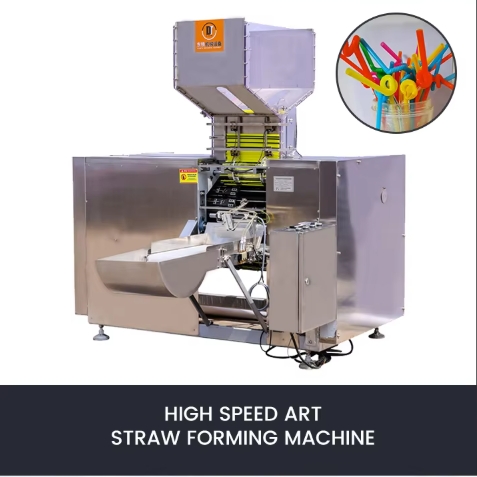
A bendable straw — also described as a flexible straw, a flexi straw or a U-shaped straw depending on the finished geometry — is a drinking straw with a corrugated section near one end that lets the upper part fold over without collapsing. That corrugated zone is what turns an ordinary extruded tube into a product a dairy packer, a juice brand or a quick-service restaurant can put into a carton or a cup.
Three mechanical requirements separate a bendable straw from a straight one, and all three are forming problems rather than cutting problems:
- A uniform corrugation. The bellows must be formed evenly around the full circumference of the tube. An uneven corrugation kinks, leaks or splits at the bend point, which is exactly the failure a beverage brand will not accept in a filling line.
- A forming needle that survives the cycle. The needle that creates the corrugation is the component that historically fails first when cycle speed rises. "High-speed running with no needle breakage" is therefore the single performance claim that matters most on a flexible straw line.
- Controlled diameter tolerance. Dongtie's embossing technology controls standard straw diameter tolerance at ±0.05 mm, which keeps the finished bendable straw consistent enough for the downstream filling and packaging equipment it will be fed into.
The Problem: Bending Capacity Caps a Flexible Straw Business
Flexible straw demand is contract-driven. Dairy packers, beverage brands, food-service distributors and quick-service chains order by container on fixed schedules, and they expect the same bending behaviour in every straw in every shipment. Manual and semi-automatic bending processes struggle on all three counts: output, consistency and maintenance load. When a bending needle breaks, the line stops, the batch is questioned, and the operator becomes the bottleneck.
The output gap is documented rather than assumed. Published industry specification data from straw machinery suppliers lists typical automatic straw bending machines in the range of roughly 200–300 pieces per minute. Dongtie's published benchmark for the DT-1200 high-speed flexible straw forming machine is no less than 1,000 straws per minute at high speed with no needle breakage — a different category of throughput that changes how many machines a flexible straw duty actually needs.
There is also a machine-count problem. Dongtie's replacement case records that one high-speed flexible straw forming machine replaces five traditional machines. For a factory planning a straw production line, that ratio is the difference between five points of lubrication, alignment and spare-part management and one.
Industry Background: Straw Machinery Demand Keeps Climbing
The equipment side of the straw industry is expanding, and the demand is coming from several directions at once:
- The global straw machine market was estimated at USD 962.55 million in 2024 and is projected to reach USD 1,793.41 million by 2035, a CAGR of 5.82% (Market Research Future).
- Industrial end-users are projected to account for 40.1% of straw machine market share as of 2025 projections (Dataintelo), which reflects the shift from manual production to machine-based capacity.
- China accounts for over 66% of the global export value of flexible straw bending machinery, based on customs trade data reported by Zauba for HS code 84778090 — the classification China's GACC lists as the primary code for drinking straw machines.
- The global paper straw market was valued at USD 2.6 billion in 2024, with paper straw machines forecast at a 15.6% CAGR between 2025 and 2030 as plastic bans continue to spread (Grand View Research).
- Demand for U-shaped straw machines is growing specifically around the aseptic packaging industry, such as milk cartons (Mordor Intelligence).
Regulatory pressure runs alongside the volume growth. Flexible straws that end up in food-contact applications sit inside a documented compliance framework: machinery sold into the EU must comply with Machinery Directive 2006/42/EC and carry the CE mark, EN ISO 12100 is the primary harmonized standard for machinery safety, and food-contact considerations fall under Regulation (EC) No 1935/2004. On the environmental side, plastic straws are still estimated at around 4% of total marine plastic waste by piece, which keeps regulatory replacement pressure on the category.
Inside the Machine: The Embossing and Forming Module
The patented forming core
The DT-1200's core forming components use Dongtie's self-developed patented technology, Patent No. ZL202020756632.1. The patent is not a marketing label; it describes four mechanical decisions that decide whether a bending line runs or stops:
- Independent embossing and forming module. Separating the two functions allows each to be tuned to its own job, which raises achievable production output compared with a single combined forming stage.
- High-efficiency embossing technology. This relaxes the tolerance limits for incoming tube blanks. The practical benefit for a buyer is a wider acceptable range of purchased tube and less scrap, with standard straw diameter tolerance controlled at ±0.05 mm.
- Precision feeding unit. Consistent tube positioning at the entry of the forming stage is what makes long-term stable machine operation possible rather than short test runs.
- Separately adjustable embossing and forming modules. Because the two modules are adjusted independently, maintenance difficulty drops — an operator can correct one stage without re-setting the other.
Control, monitoring and uptime
The machine is equipped with a PLC control system that displays real-time operating status. On a malfunction the machine auto-stops and shows a fault code on screen, and an automatic counting function supports production records. On the service side, lubrication, cleaning and troubleshooting points are positioned for access by frontline operators rather than specialist technicians, and remote video technical guidance is available for common faults.
Certificate coverage buyers can verify
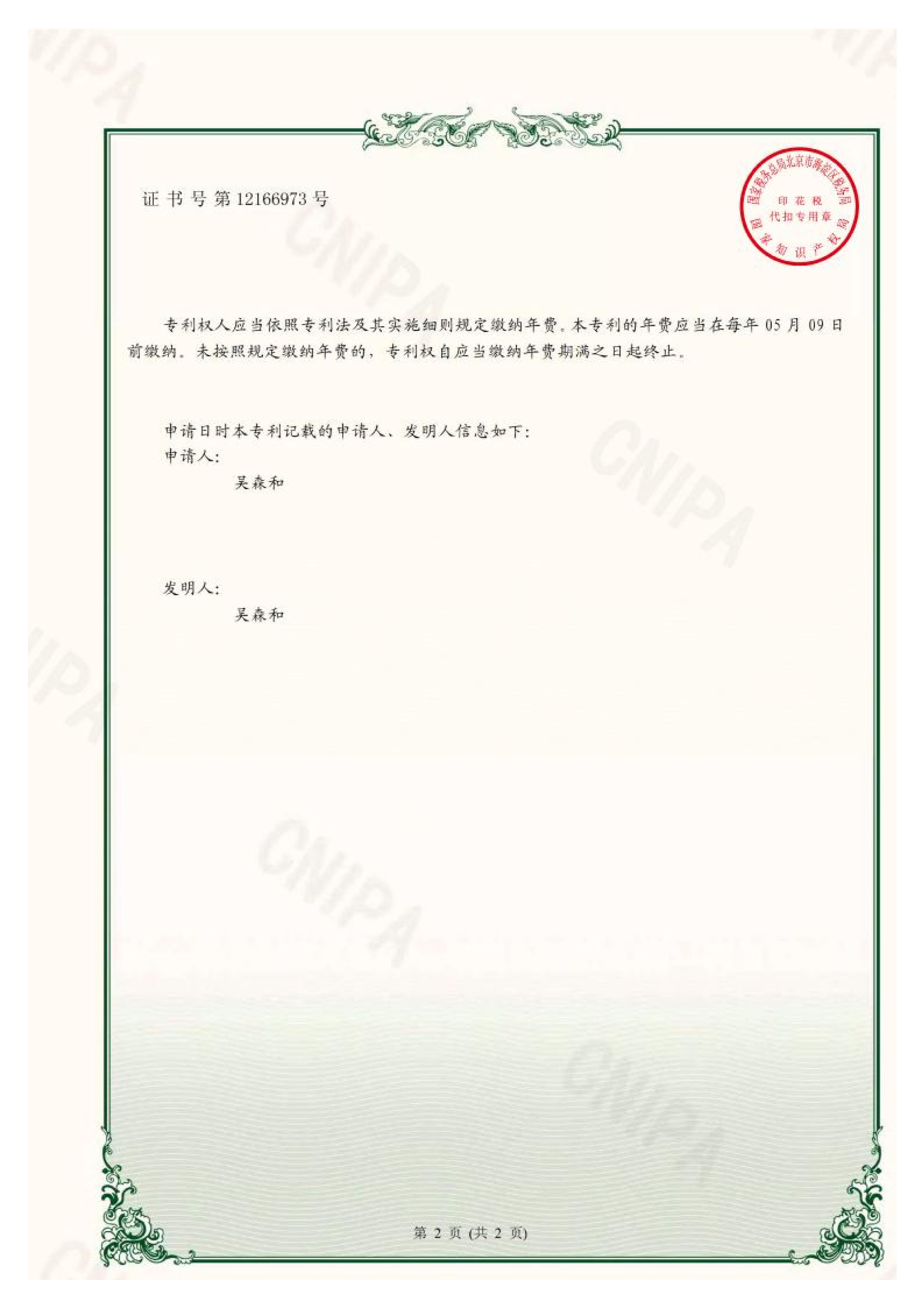
The utility model patent behind the machine is registered as Certificate of Utility Model Patent No. 12166973, issued by the China National Intellectual Property Administration (CNIPA). The certificate applies to the High-Speed Flexible Straw Forming Machine, Model DT-1200. It was issued on 2020-12-18 and runs until 2030-05-09. The certificate is mainly valid in China, while the products can be sold worldwide.
Wearing parts and designed service life
Forming needles and molds are the parts that decide whether a high-speed bending line can run for months without an unplanned stop. On the DT-1200, these key wearing parts are reinforced with special materials and craftsmanship and carry a designed service life of over one year — a specification worth comparing directly against the spare-part consumption pattern of a semi-automatic bending setup.
Why One Machine Replaces Five
The replacement ratio is documented in Dongtie's own field record rather than in a brochure claim: one high-speed flexible straw forming machine replaces five traditional machines, running at high speed without needle breakage and outputting at least 1,000 straws per minute. That record covers roughly 60 sets supplied over a three-year period to straw factories in Southeast Asia, the Middle East and China, used mainly to replace manual or semi-automatic processes and raise automation level.
For a factory owner, the operational reading of a 5-to-1 replacement is straightforward: fewer machines to monitor, fewer lubrication and alignment points, a smaller set of spare-part types to hold, and one production duty handled by one operator-monitored unit rather than a row of semi-automatic stations. The machine is built for fully automatic continuous operation with manual monitoring and regular maintenance, and it can work standalone or be connected into a larger straw production line.
How a Tube Becomes a Bendable Straw: Step by Step
- Tube blank feeding. Finished straight tube blanks are loaded and advanced by the precision feeding unit. Because the embossing stage relaxes incoming tube tolerance, the material specification does not need to be perfect to the last hundredth of a millimetre.
- Embossing. The corrugated bending zone is pressed into the tube wall by the embossing module, which creates the bellows that will allow the straw to flex.
- Forming and bending. The patented forming components shape the corrugated section around the forming needle. This is the stage where conventional high-speed equipment risks needle breakage; the DT-1200 is specified to run at high speed without it.
- In-line inspection. Multiple on-line detectors monitor material shortage, defective forming and length deviation, and automatically reject non-conforming product in real time. This is the mechanism that protects batch consistency without adding manual inspection labour.
- Counting and status monitoring. An automatic output counter and operating-status monitor record production; the PLC auto-stops the machine on a fault and displays the fault code.
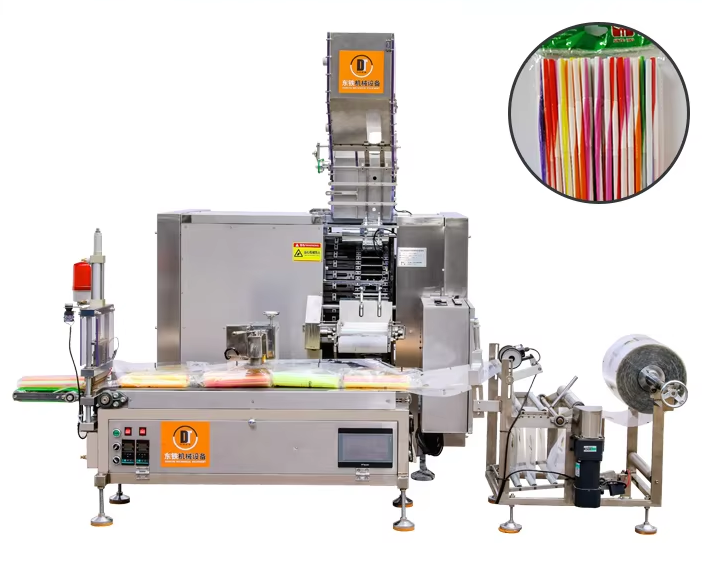
- Cooling and sealing. Matched upstream and downstream equipment includes a sealing and cooling unit, which stabilises the formed geometry before handling.
- Optional downstream integration. Optional modules such as a fixed-quantity packaging system and an automatic stacking unit can be matched to build an integrated line, connected through a conveyor system.
- Continuous run. The machine is designed for a normal-temperature workshop with a stable power supply and a connected raw-material feed — the standard condition for continuous mass production.
Verified Specification and Constraint Data
These are the parameters that a technical buyer can check against a quotation, a factory test run or a certificate file. All values below are published Dongtie specifications for the DT-1200 high-speed flexible straw forming machine.
| Parameter | Verified value (DT-1200) |
|---|---|
| Product type | High-speed flexible straw forming machine |
| Model | DT-1200 |
| Construction material | Stainless steel |
| Rated power | 5.5–6.5 kW |
| Protection grade | IP55 |
| Working pressure | 1.500–6.000 MPa |
| Working temperature | 100–200 °C |
| Published output range (product specification) | 3,000–5,500 pcs/min |
| Operating benchmark | No less than 1,000 straws per minute at high speed, no needle breakage |
| Diameter tolerance | ±0.05 mm standard straw diameter |
| Designed service life of key wearing parts (forming needles, molds) | Over 1 year |
| Core technology | Patented embossing and forming module, Patent No. ZL202020756632.1 |
| Patent certificate | Certificate of Utility Model Patent No. 12166973, issued by CNIPA; issued 2020-12-18, valid until 2030-05-09; mainly valid in China, products can be sold worldwide |
| Operation mode | Fully automatic continuous operation with manual monitoring and regular maintenance; standalone or line-connected |
| Control system | PLC with real-time status display, auto-stop with fault codes, automatic output counting |
| In-line inspection | Detectors for material shortage, defective forming and length deviation with automatic rejection |
| Matched equipment | Feeder, sealing and cooling unit, packaging machine, conveyor system |
| Minimum order quantity | 1 set |
| Monthly production capacity | 20 sets |
| Lead time | 30 days |
| Customization scope | Molds, production capacity specifications, control systems and line connection schemes |
High-Speed Bendable Forming vs. Conventional Straw Bending
Comparison only helps when both columns are traceable. The table below separates Dongtie's verified first-party data from published third-party specification data, and marks anything the reviewed sources do not state.
| Decision metric | DT-1200 high-speed flexible straw forming machine | Conventional / semi-automatic bending setup | Basis |
|---|---|---|---|
| Machines required for one flexible straw duty | 1 | 5 traditional machines | Dongtie replacement case |
| Published bending output | No less than 1,000 straws/min | Approximately 200–300 pcs/min for typical automatic straw bending machines | Dongtie published benchmark; supplier specification data published by KEZHI |
| Needle behaviour at high speed | Runs at high speed without needle breakage | Not stated in the sources reviewed | Dongtie replacement case |
| Production mode | Fully automatic continuous operation, manual monitoring and regular maintenance | Manual or semi-automatic process | Dongtie application and case data |
| Mold flexibility | Custom molds required for different straw diameters and bending shapes; quick switching between calibers and bending angles | Not stated in the sources reviewed | Dongtie application and product data |
| Key wearing-part life | Designed service life over 1 year for forming needles and molds | Not stated in the sources reviewed | Dongtie product data |
Use Cases: Where Flexible Straw Mass Production Fits
- Dairy and aseptic packaging. U-shaped straws for milk cartons and similar aseptic packs are one of the growth segments for U-shaped straw forming equipment. Dongtie's case record includes domestic dairy factory production of 3.8mm U-shaped straws on its small-diameter U-shaped straw forming machine.
- Beverage and food service. High-speed flexible straw output supports quick-service restaurant chains and food-service distributors that order flexible straws by container on fixed schedules.
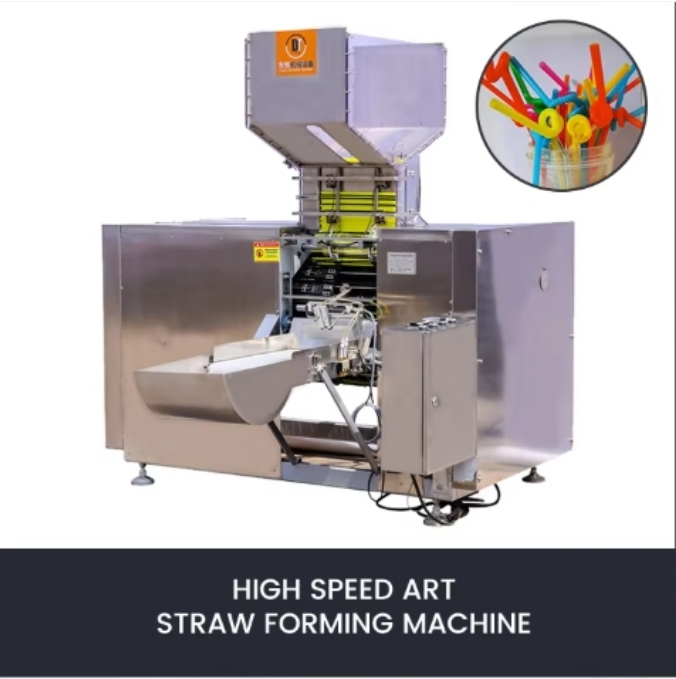
- Decorative and art straws. The Dongtie product range includes a high-speed art straw forming machine, a 6mm art straw forming machine and a 12mm large-diameter art straw forming machine. For a Middle East client, the company produced 10mm decorative straws as a custom specification.
- Export-oriented factories. Dongtie serves Southeast Asia, the Middle East, Europe and other global markets, and export shipments are handled with container loading support, as documented in its Southeast Asia loading-site records.
- Multi-variety OEM/ODM production. Factories that run several diameters and bend angles on one machine rather than purchasing dedicated lines for each specification use the modular mold-change design and optional downstream packaging modules to stay flexible on order mix.

Custom-Tuned Molds: Diameters, Bend Angles and Local Straw Specifications
One of the first constraints a newcomer to flexible straw production discovers is that the straw specification is not universal. Carton dimensions, filling equipment and market expectations differ, so the machine must be matched to the straw. Two verified statements cover this:
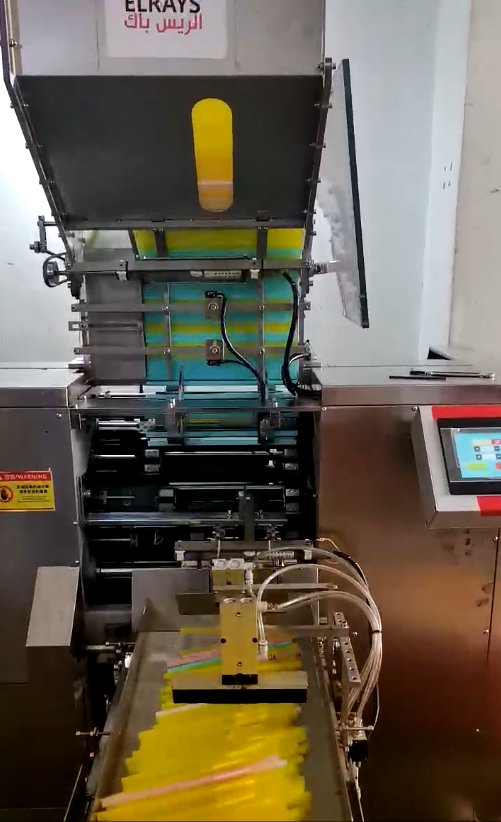
- By changing the corresponding molds, the machine can manufacture flexible straws with different diameters and bending angles to meet diversified production demands. Customers may purchase matched molds based on their required specifications.
- Custom molds are required for different straw diameters and bending shapes. Special standards for raw material specifications and surface treatment apply, and material compatibility and mold solutions are confirmed before order placement.
The wider customization scope covers molds, production capacity specifications, control systems and line connection schemes, with the full customizable scope confirmed with the sales team. In Dongtie's case record, this is described as a custom-tuned mold solution for local straw specifications — the reason an export machine can match the straw geometry a specific market actually buys, rather than being limited to one standard size.
The Dongtie equipment range therefore spans the practical specification ladder rather than a single model: a 5mm flexible straw forming machine, a 6mm high-speed straw bending machine, a 3.8mm U-shaped straw forming machine, a small-diameter U-shaped straw forming machine, a 12mm pointed-tip straw bending machine and a 12mm pointed-tip high-speed straw bending machine, alongside the art straw and large-diameter decorative straw machines. Which of these applies depends on the diameter and bend angle your market requires.
FAQ
1. What certification does the DT-1200 hold, and how should a buyer check CE compliance?
The High-Speed Flexible Straw Forming Machine (Model DT-1200) is protected by Certificate of Utility Model Patent No. 12166973, issued by the China National Intellectual Property Administration. The certificate was issued on 2020-12-18 and is valid until 2030-05-09; it is mainly valid in China, while the products can be sold worldwide. CE marking is a separate matter: machinery sold into the EU must comply with Machinery Directive 2006/42/EC and carry the CE mark, with EN ISO 12100 as the primary harmonized machinery-safety standard and Regulation (EC) No 1935/2004 governing food-contact considerations. Buyers should request the documentation set that applies to their destination market; Dongtie's factory inspection includes a pre-delivery test run and functional verification, and factory inspection reports can be provided on demand.
2. Can one machine really replace five traditional machines?
Yes, according to Dongtie's replacement case: one high-speed flexible straw forming machine replaces five traditional machines, runs at high speed without needle breakage and outputs at least 1,000 straws per minute. The record covers roughly 60 sets supplied over three years to straw factories in Southeast Asia, the Middle East and China, where the machines were used to replace manual or semi-automatic processes and raise automation level. The practical result stated in that record is higher automatic productivity with consistent finished product quality.
3. What determines the configuration and cost scope of the machine?
Cost is driven by configuration, not by a single model number. Three factors decide the commercial scope: the mold sets required for your straw diameters and bending angles, the customization scope (molds, production capacity specifications, control systems and line connection schemes), and whether you add optional downstream modules such as a fixed-quantity packaging system or an automatic stacking unit. The full customizable scope is confirmed with the sales team, and the minimum order quantity is 1 set. The most accurate way to price a project is to submit your straw specification and target output for a configuration-based quotation rather than comparing headline machine prices.
4. How can a buyer validate output quality before shipment?
Validation runs on three verifiable checks. First, factory inspection includes a pre-delivery test run and functional verification, and factory inspection reports can be provided on demand. Second, material compatibility and mold solutions are confirmed before order placement, so the straw geometry is agreed before the machine is built. Third, Dongtie runs its own straw production workshop with over 10 full production lines, where on-site training can be arranged, and remote video technical guidance is available for common faults — so a buyer can see the equipment running on real production before committing to a full line.
5. What are the MOQ, monthly capacity and lead time?
The minimum order quantity is 1 set, monthly production capacity is 20 sets, and the standard lead time is 30 days. After-sales support includes installation and commissioning, remote technical support and spare parts supply; warranty terms and response time are recommended to be confirmed before purchase, so they are written into the order rather than assumed.
Next Step: Match the Machine to Your Straw Specification
If you are evaluating a high-speed bendable straw forming machine for a flexible straw project, the fastest way to a usable answer is to send three things: your straw diameter, your required bend angle, and your target output per minute. Dongtie Mechanical Equipment will match the DT-1200 configuration, the mold set and the line connection scheme to those numbers.
Download the full product catalogue:Dongtie straw forming equipment brochure (PDF)
Website:www.zsdtjx.com
Email: 843681276@qq.com
Tel / WhatsApp: +8613680252932
Address: 23-3/F, Xicheng Road, West District, Xiaolan Town, Zhongshan City
Key Takeaways
- A high-speed bendable straw forming machine is defined by its embossing and forming module, not by its cutting speed: the corrugation, the forming needle and the diameter tolerance are what decide output quality.
- Dongtie's patented forming technology (Patent No. ZL202020756632.1), covered by Certificate of Utility Model Patent No. 12166973, targets the industry's chronic high-speed needle breakage problem directly.
- The verified operating benchmark is no less than 1,000 straws per minute with no needle breakage, inside a machine count where one unit replaces five traditional machines.
- Custom-tuned molds for different diameters and bending angles are the mechanism that adapts the same machine to local straw specifications, including 3.8mm U-shaped, 5mm flexible, 6mm and 12mm pointed-tip, and decorative art straw formats.
- The commercial constraints a buyer should confirm in writing are configuration scope, MOQ of 1 set, monthly capacity of 20 sets and a 30-day lead time.
Have Questions or Need More Details?
Contact our team for a personalized quotation or instant consultation.
Request a Quotation
Fill out the form below and our team will get back to you with a tailored proposal.
WhatsApp Direct Chat
Prefer to chat in real-time? Message us on WhatsApp for instant assistance & quick answers.
- Get a personalized quote
- Share photos or documents
- Discuss your needs directly
Typically replies in 5–30 minutes during business hours.