Long-Term Support FAQ for High-Speed Flexible Straw Forming Machine Buyers
Short answer: long-term support for a high-speed flexible straw forming machine is a defined set of services, not a verbal promise. It covers installation and commissioning, operator training, remote video troubleshooting for common faults, spare parts supply, and full-set after-sales technical support for overseas sites. DONGTIE MECHANICAL EQUIPMENT supplies these services with its flexible straw forming machines and arranges operator training inside its own straw production workshop, which runs more than 10 full production lines. The questions below are the ones that decide whether a shortlisted machine becomes a reliable line for the next several years.
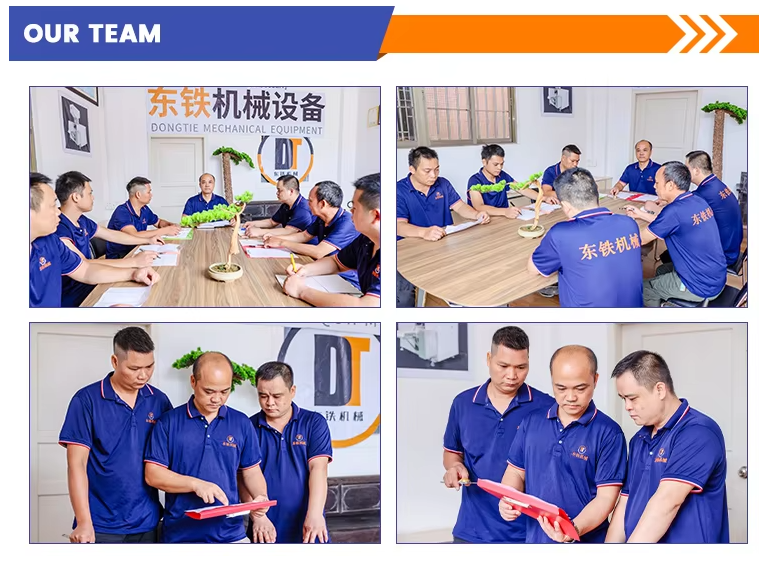
DONGTIE MECHANICAL EQUIPMENT — the team that handles commissioning, operator training and overseas technical support for straw forming lines.
Problem Definition: The Support Gap Only Appears After Delivery
Machine comparisons usually settle on output, mold range and price. Support enters the conversation later, at the point where it can no longer change the decision. That is the gap this page addresses.
On a line that runs at a minimum of 1,000 straws per minute without needle breakage, a stopped machine is not a neutral event. Needle damage, mold misalignment and operator error are the routine causes, and each of them has a different owner: the first two are service and spare-part questions, the third is a training question. A buyer who has not settled all three before the purchase order will settle them under production pressure instead.
Two design provisions shorten the path from fault to fix on the DT-1200. The PLC control system displays real-time operating status, and the machine stops automatically on a malfunction with the fault code shown on screen; automatic counting keeps output records separate from operator notes. Combined with remote video guidance for common faults, a displayed fault code becomes something a technician can act on in a scheduled call rather than something that waits for a site visit.
The second, quieter risk sits in staffing. High-speed lines are often handed to operators who were trained on slower or semi-automatic equipment. Dongtie's design intent addresses that directly: the humanized layout supports smoother operation and easier parameter adjustment, and novice operators can master the machine with full on-site training.
Three questions a decision-stage buyer should answer before signing
- Who commissions the machine, and is commissioning inside the supply scope or billed as an extra?
- Who trains the operators, and where does that training take place — on drawings, on a running line, or in the buyer's plant?
- Who supplies the wear parts and additional molds after the first year, and from which location?
Industry Background: A Larger Installed Base, Supported Differently
Market context explains why support has become a structural purchasing question rather than a courtesy. The global straw machine market was estimated at USD 962.55 million in 2024 and is projected to reach USD 1,793.41 million by 2035, a CAGR of 5.82%, according to Market Research Future. Industrial end-users accounted for 40.1% of market share in 2025 projections, per Dataintelo.
Material regulation is reshaping the same installed base. Paper straw machines are expected to grow at a CAGR of 15.6% between 2025 and 2030 as plastic bans take effect, according to Grand View Research — a shift that pushes existing lines toward material and mold reconfiguration rather than simple volume expansion. Reconfiguration is a support event: new molds, new settings, retraining.
Supply is concentrated. China accounts for over 66% of the global export value of flexible straw bending machinery, based on Zauba and US customs data. The practical consequence for an overseas buyer is that the manufacturer is typically thousands of kilometres away, so support has to run through three channels that do not require travel: remote diagnosis, shipped spare parts and structured training. On-site attendance is reserved for installation, commissioning and hands-on operator training.
Compliance sits alongside this. Under China's GACC classification, drinking straw machines are primarily exported under HS code 84778090. For EU destinations, machinery must comply with the Machinery Directive 2006/42/EC and carry the CE mark; EN ISO 12100 is the primary harmonized safety standard, and Regulation (EC) No 1935/2004 governs the transfer of constituents to food. These are destination obligations, and they determine which documents a buyer should request during the support conversation rather than after the container arrives.
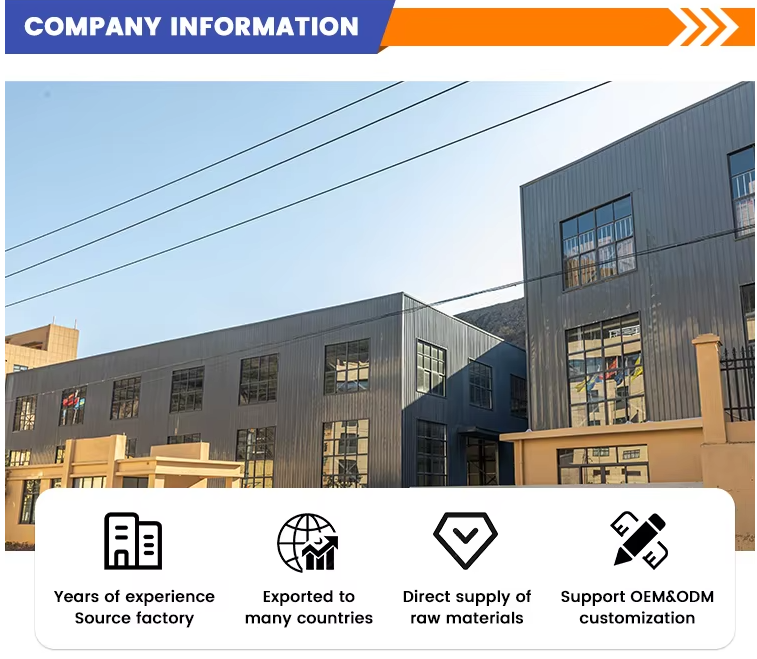
Zhongshan Dongtie Machinery Co., Ltd. has focused on straw machinery manufacturing since 2010 and supplies overseas straw producers through a documented service arrangement.
The Detailed Solution: How DONGTIE Structures Support for a Straw Line
DONGTIE MECHANICAL EQUIPMENT is the brand used by Zhongshan Dongtie Machinery Co., Ltd., a straw machinery manufacturer based on Xicheng Road, Xiaolan Town, Zhongshan City, China, which has focused on straw machinery manufacturing since 2010 and builds flexible straw forming machines, small-diameter U-shaped straw forming machines, decorative straw forming machines and high-speed straw bending machines for processing factories and packaging enterprises.
Its long-term support model rests on five service provisions, each of which answers a specific post-purchase question.
1. Installation and commissioning are part of the delivery
Installation and commissioning are provided with the machine. This matters most for a first line, where foundation, power supply, working pressure and material feed have to be aligned before the first production run. Because commissioning is the same event in which the operators see the machine working on their own material, it doubles as the practical handover point.
2. Operator training happens on running lines, not on slides
On-site training can be arranged in Dongtie's own straw production workshop, which is equipped with over 10 full production lines. Trainees work next to machines that are producing, which is a different learning environment from a showroom demonstration. The stated outcome is that novice operators can master the machine with full on-site training — a claim that matters because labour turnover, not machine failure, is the most common reason a well-installed line drifts out of specification.
3. Remote video guidance covers common faults
Remote video technical guidance is available for common faults. The machine shows fault codes on screen and stops automatically on malfunction, so a remote call starts with an identified condition rather than a description of symptoms. This reduces diagnosis time on the categories of fault that recur across installations. It does not replace on-site intervention for mechanical damage — a boundary worth stating plainly, since it sets realistic expectations for response planning.
4. Spare parts supply is included in the arrangement
Spare parts supply is part of the support package, which means wear parts and replacements come from the manufacturer that built the machine rather than from a third-party channel with unverified tolerances. On a line built around a ±0.05 mm standard straw diameter tolerance, part provenance is a quality variable, not an administrative detail.
5. Full-set after-sales technical support is available for overseas sites
Full-set after-sales technical support is available for overseas sites, covering the machine as a system rather than individual components in isolation. An overseas buyer should confirm, per order, two operational details during quotation: the contact path used for technical escalation, and the arrangement for shipping parts to their port.
6. Expansion and maintenance are designed in from the start
Long-term reliability is partly a design question. Dongtie's equipment applies self-developed domestic patented technology, Patent No. ZL202020756632.1, with four consequences that show up during years of operation:
- an independent embossing and forming module that effectively boosts production output;
- high-efficiency embossing technology that relaxes tolerance limits for tube blanks, with standard straw diameter tolerance controlled at ±0.05 mm;
- a precision feeding unit that supports long-term stable machine operation;
- separately adjustable embossing and forming modules that greatly reduce maintenance difficulty.
Wide mold compatibility and easy line connection extend the same logic to future capacity: additional diameters and bend angles are handled by changing molds, and the forming unit can be connected to downstream packaging equipment.
What the DT-1200 baseline tells you about service load
The published parameters are the starting point for planning maintenance and spares, because they define the operating envelope the support arrangement has to keep the machine inside.
| Parameter | DT-1200 High-Speed Flexible Straw Forming Machine | Why it matters for long-term support |
|---|---|---|
| Output | 3,000–5,500 pcs/min | Continuous high-speed duty makes scheduled maintenance and needle integrity checks routine |
| Power | 5.5–6.5 kW | Defines the electrical supply preparation required at installation |
| Working pressure | 1.500–6.000 MPa | Air supply stability affects forming consistency between service intervals |
| Working temperature | 100–200 °C | Heat-related wear is a maintenance item, not a fault category |
| Protection grade | IP55 | Supports operation in normal-temperature workshop environments |
| Material | Stainless steel | Longer service life and easier cleaning between product changeovers |
Stated comparison with traditional ordinary flexible-straw forming machines
Dongtie's own comparison states that one unit replaces five traditional machines and achieves a minimum output of 1,000 straws per minute without needle breakage, with a 50% reduction in processing cost compared with alternatives. Read those figures as a structural argument about service load: fewer units, fewer operator stations, fewer spares categories and fewer fault sources to manage at the same output.
| Comparison point | Traditional ordinary flexible-straw forming machines | DONGTIE high-speed flexible straw forming machine |
|---|---|---|
| Units needed for equivalent output | 5 units | 1 unit |
| Stated minimum output without needle breakage | Not stated in the source comparison | 1,000 straws per minute |
| Processing cost | Baseline | 50% reduction, as stated in the source comparison |
| Automation level | Baseline | Higher automation, with PLC status display and fault codes |
| Mold compatibility | Baseline | Wide mold compatibility across diameters and bend angles |
| Line connection | Baseline | Easy line connection to downstream equipment |
Step-by-Step Breakdown: The Support Sequence From Configuration to Expansion
Support is easier to evaluate when it is read as a sequence with defined handover points. The seven steps below describe how a high-speed flexible straw forming machine moves from configuration to a running, expandable line.
- Step 1 — Specification and mold confirmation before order placement. Custom molds are required for different straw diameters and bending shapes, and material compatibility and mold solutions are confirmed before the order is placed. This is the step that prevents a mismatch discovered only after the container is opened.
- Step 2 — Export documentation. Drinking straw machines are primarily classified under HS code 84778090 in China's GACC data. Confirm the classification, the destination-market declaration (CE under 2006/42/EC for the EU) and the shipping documents with your broker before dispatch.
- Step 3 — Installation and commissioning on site. The machine is installed and commissioned against its operating envelope: power at 5.5–6.5 kW, working pressure between 1.500 and 6.000 MPa, working temperature of 100–200 °C.
- Step 4 — Operator onboarding. Training covers the PLC screen, fault-code reading, automatic counting, and parameter adjustment. Where agreed, this can be arranged in Dongtie's own workshop alongside more than 10 running production lines.
- Step 5 — First production runs with remote backup. Remote video guidance for common faults supports the ramp-up period, when operator questions are most frequent and fault codes are easiest to resolve with a second pair of eyes.
- Step 6 — Spare parts planning. Because spare parts supply is included, the wear-part list is sourced from the original manufacturer, protecting the ±0.05 mm diameter tolerance that the forming process depends on.
- Step 7 — Expansion. Additional diameters or bend angles are introduced through mold changes, and the line is extended by connecting downstream packaging equipment, supported by full-set after-sales technical support for overseas sites.
Use Cases: Four Buyer Situations Where Support Provisions Decide the Outcome
1. A greenfield line in an overseas market with no in-house technician
Here the entire technical baseline is built during commissioning and training. Installation and commissioning provided as part of the supply, plus remote video guidance for common faults, plus spare parts supply, is a complete support loop. A buyer in this situation should also confirm where the nearest trained personnel sit, because the first six months carry the highest learning load.
2. A small or medium factory upgrading from manual or semi-automatic bending
The machine is capable of a minimum of 1,000 straws per minute without needle breakage, which is a different operating rhythm from semi-automatic equipment. The stated 50% reduction in processing cost only materialises if operators run the line correctly. Full on-site training for novice operators is therefore not a soft benefit — it is the condition under which the cost comparison holds.
3. A multi-diameter producer running 5 mm, 6 mm, 3.8 mm and 12 mm formats
Producers of flexible, U-shaped and decorative straws change molds regularly. Wide mold compatibility and separately adjustable embossing and forming modules greatly reduce maintenance difficulty in this scenario, because each module can be corrected without dismantling the other. Purchase the molds with the machine rather than after the first order arrives.
4. A factory connecting forming to packaging
When a forming unit feeds a packaging system, downtime on either side stops the other. Easy line connection and full-set after-sales technical support matter more than the individual machine specification here, because the fault may sit at the interface rather than in either unit.
Comparison Table: Support Provisions to Compare Before You Sign
The table below separates what Dongtie states as provided from what any buyer should still confirm in writing for their own site. The third column is a checklist that applies to every supplier, not a criticism of any one of them.
| Support element | What DONGTIE provides (verified) | What to confirm in writing with any supplier |
|---|---|---|
| Installation and commissioning | Provided with the machine | Scope, number of days, who bears travel and accommodation |
| Operator training | On-site training arrangeable in Dongtie's own workshop with over 10 full production lines; novice operators can master the machine with full on-site training | Number of trainees, duration, language of instruction, whether training is in China or at the buyer's plant |
| Remote troubleshooting | Remote video technical guidance for common faults, supported by PLC fault codes and automatic machine stop on malfunction | Contact channel, escalation path, and how non-common faults are handled |
| Spare parts | Spare parts supply included | Wear-part list, recommended stock level, shipping method and destination port |
| Overseas technical support | Full-set after-sales technical support available for overseas sites | Which systems are covered — machine, molds, controls — and the escalation owner |
| Expansion and molds | Wide mold compatibility; easy line connection; separately adjustable embossing and forming modules | Mold price per diameter and bend angle; changeover time; compatibility with existing downstream equipment |
FAQ: Long-Term Reliability and Support Questions Buyers Ask
1. Which compliance documents should an overseas buyer confirm before a high-speed flexible straw forming machine ships?
China's GACC data identifies HS code 84778090 as the primary classification for drinking straw machines, so that is the expected export heading. For EU destinations, machinery must comply with the Machinery Directive 2006/42/EC and carry the CE mark; EN ISO 12100 is the primary harmonized standard for machinery safety, and Regulation (EC) No 1935/2004 governs the transfer of constituents to food. Confirm the declaration that applies to your specific destination with the supplier and your import broker, since obligations differ by market. Dongtie's verified overseas provision is installation and commissioning, training, remote video guidance for common faults, spare parts supply and full-set after-sales technical support; the certification scope for a given order should be confirmed as part of the quotation.
2. Who installs and commissions the line, and where does operator training take place?
Installation and commissioning are provided as part of the machine supply, so the line is established against its operating parameters rather than assembled from drawings. Operator training can be arranged on site in DONGTIE MECHANICAL EQUIPMENT's own straw production workshop, which is equipped with over 10 full production lines; novice operators can master the machine with full on-site training. Training covers the PLC control screen, fault-code reading, automatic counting and parameter adjustment, which is the same interface operators use for daily running.
3. What belongs in the long-run cost of ownership beyond the machine price?
Four cost lines matter. First, processing cost: Dongtie's stated comparison is a 50% reduction in processing cost versus alternatives, with one unit replacing five traditional machines. Second, energy: power is 5.5–6.5 kW, and consumption and energy-efficiency data are available upon request, so the figure can be calculated for your local tariff. Third, wear parts and molds, which are configuration-dependent and should be quoted line by line. Fourth, downtime, which is where the support arrangement earns its value — a minimum output of 1,000 straws per minute without needle breakage is only sustainable if faults are resolved quickly.
4. How can we validate that the machine suits our straw specification before committing?
Validation starts before the order. Custom molds are required for different straw diameters and bending shapes, and material compatibility and mold solutions are confirmed before order placement — this is the stage where your tube blank, diameter and bend angle are matched to the tooling. After delivery, installation and commissioning establish the line in your plant on your material, and operator training transfers the setting knowledge to your team. Buyers who want to see running equipment first can request training in Dongtie's workshop, where more than 10 full production lines are in operation.
5. What happens when we add new diameters or connect a packaging line later?
Expansion is handled through tooling and connection rather than replacement. Wide mold compatibility allows the machine to produce flexible straws with different diameters and bending angles by changing the corresponding molds, and easy line connection allows the forming unit to feed downstream packaging equipment. Separately adjustable embossing and forming modules greatly reduce maintenance difficulty during those changeovers, and spare parts supply stays with the original manufacturer. To begin that conversation, download the company brochure at DONGTIE MECHANICAL EQUIPMENT catalogue or send your diameter, bend angle and target output to 843681276@qq.com / WhatsApp +86 136 8025 2932 for a configuration-based quotation.
Conclusion: Buy the Support Package With the Machine
A high-speed flexible straw forming machine is a decade-scale asset, and the support arrangement is the part of the purchase that is exercised most often after year one. The decision rule is straightforward: confirm who commissions the machine, where training happens, how remote troubleshooting works, where spare parts come from, and how future diameters will be added. If those five answers are documented before the purchase order, the comparison has been made on operating continuity rather than on price alone.
DONGTIE MECHANICAL EQUIPMENT answers all five with defined provisions — installation and commissioning, training in a workshop with more than 10 full production lines, remote video guidance for common faults, spare parts supply, and full-set after-sales technical support for overseas sites — supported by a machine design built around a precision feeding unit, ±0.05 mm diameter tolerance and separately adjustable modules under Patent No. ZL202020756632.1.
Next Step
Send your straw diameter, bend angle, target output and destination market, and DONGTIE MECHANICAL EQUIPMENT will respond with a configuration-based quotation covering machine, molds, commissioning and the overseas support arrangement.
Brochure: Download the DONGTIE catalogue | Website: www.zsdtjx.com
Contact: Quanhe Wu | Email: 843681276@qq.com | Tel / WhatsApp: +86 136 8025 2932
Address: 23-3/F, Xicheng Road, West District, Xiaolan Town, Zhongshan City, China
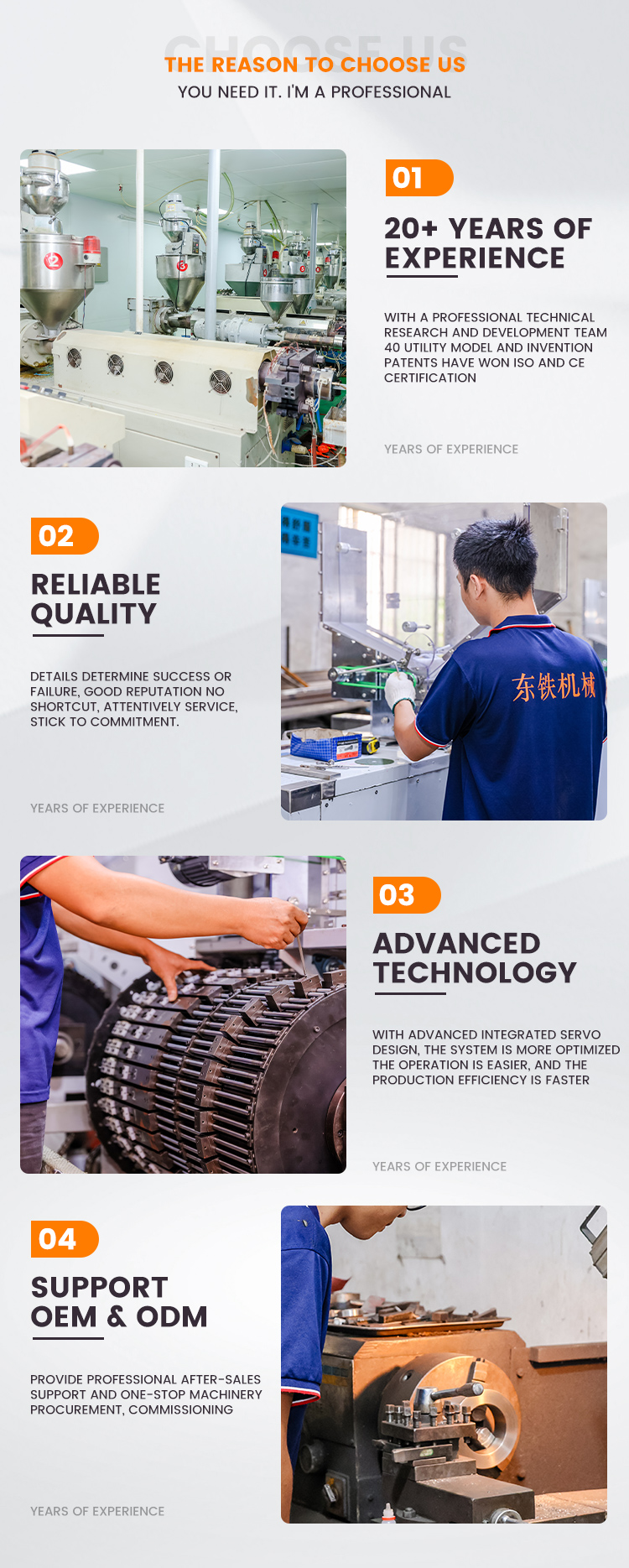
Long-term support is the part of a straw line purchase that is used most often — confirm it before the machine ships, not after.
Have Questions or Need More Details?
Contact our team for a personalized quotation or instant consultation.
Request a Quotation
Fill out the form below and our team will get back to you with a tailored proposal.
WhatsApp Direct Chat
Prefer to chat in real-time? Message us on WhatsApp for instant assistance & quick answers.
- Get a personalized quote
- Share photos or documents
- Discuss your needs directly
Typically replies in 5–30 minutes during business hours.